Skip to content

Prostate Cancer

Prostate cancer is a disease in which cells in the prostate, a gland in the male reproductive system just below the bladder, grow out of control. Many prostate cancers grow slowly and may never cause harm, while others grow quickly and can spread. It is most common in older men.
Medically reviewed by Dr Thapana Tangshewinsirikul (Dr Tom), Oncology Director. Last reviewed 2026-09-30.
Patient Doctor Consultation
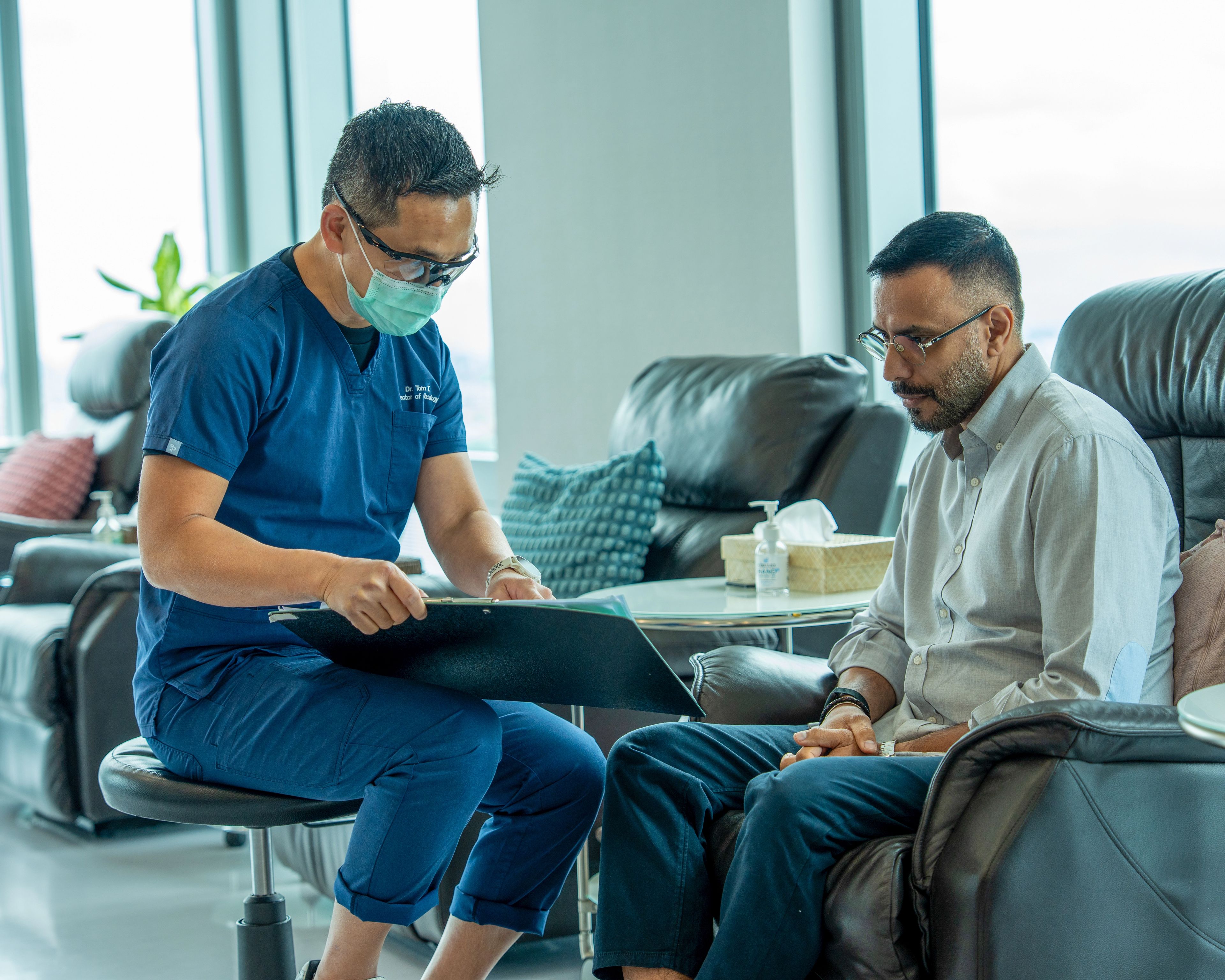
Dr Tom consulting with a patient, Verita Life Bangkok.

01 / Overview

About prostate cancer

Also known as: prostate adenocarcinoma, carcinoma of the prostate.

Prostate cancer care programmes are built to support patients navigating diagnosis, ongoing treatment, or during recovery. Verita Life designs patient treatment plans around each individual patient and their diagnosis, rather than following a single protocol. This practice ensures your treatment programme can be adapted as needed throughout your cancer journey.

02 / Types

Prostate Cancer types

Prostate cancer can affect different patients in different ways, with some forms progressing slowly and others needing more intense methods of treatment. We adapt our care to the characteristics of your personal situation and the type of prostate cancer you have, including:

  • Localised prostate cancer

    Cancer localised in the prostate gland. Contained within the prostate. Options range from active surveillance to surgery or radiation.
  • Locally advanced prostate cancer

    Cancer that has spread beyond the prostate to surrounding tissues.
  • Advanced or metastatic prostate cancer

    Cancer that has spread beyond the prostate and surrounding tissues - for example to the lymph nodes.
  • Hormone-sensitive prostate cancer

    Cancer that responds to blocking or reducing male hormones. Still responds to treatments that lower testosterone.
  • Castration-resistant prostate cancer

    Prostate cancer that continues to progress after hormone treatment. Keeps growing despite low testosterone. Treated with newer hormone drugs, chemotherapy, or targeted medicines.

03 / Symptoms

Prostate Cancer symptoms

Early prostate cancer usually causes no symptoms and is most often found through a PSA blood test. When symptoms do occur they can include:

  • Trouble starting the flow of urine
  • Frequent urination, especially at night
  • Trouble emptying the bladder completely
  • A weak or interrupted flow of urine
  • Pain in the back, hips, or pelvis that does not go away
  • Shortness of breath, feeling very tired, or a fast heartbeat

Urinary symptoms are far more often caused by a non-cancerous enlarged prostate. Persistent symptoms should still be checked.

04 / Stages

Prostate Cancer stages

The stage combines how far the cancer has spread with the PSA level and the grade of the cells, reported as a Gleason score or grade group, which describes how quickly the cancer is likely to grow.

Stages I and II are cancers confined to the prostate. Stage III has grown through the outer layer of the prostate or into nearby tissue. Stage IV has spread to lymph nodes, bones, or other organs.

Doctors also describe prostate cancer by risk group (low, intermediate, high) and, once it has spread, by whether it still responds to hormone therapy.

Stages we support: Stage I, Stage II, Stage III, Stage IV, Metastatic.

05 / Conventional care

Conventional treatment

Prostate cancer treatment depends on the risk group, the stage, your age and overall health, and the side effects you are prepared to accept. Not every prostate cancer needs treatment straight away. An oncology and urology team plans it. Verita Life does not replace this care. Our therapies are designed to support it.

Active surveillance and watchful waiting

Close monitoring with PSA tests, scans, and biopsies, holding treatment until there is a change. Standard for many low-risk cancers.

Surgery

Radical prostatectomy removes the prostate and some surrounding tissue, sometimes with nearby lymph nodes.

Radiation therapy

External beams or implanted seeds (brachytherapy) that treat the cancer in or near the prostate, often with a period of hormone therapy.

Hormone therapy

Medicines or surgery that lower or block testosterone, which prostate cancer needs to grow. Used with radiation and for cancer that has spread.

Chemotherapy, targeted therapy, and immunotherapy

Medicines for cancer that has spread or no longer responds to hormone therapy, including drugs chosen by the tumour’s genetic features.

Bone-protecting treatments

Medicines that reduce bone pain and fractures when the cancer has spread to bone.

06 / Verita Life care

Your care at Verita Life

Nurse and doctor in scrubs and face masks having a conversation while looking at notes on a desk in an office, there are three other medical professionals in the room.
Verita Life, Bangkok

How we manage integrative prostate cancer care

Our medical team at Verita Life are committed to careful planning, ongoing evaluation, and coordinated care that can be combined with traditional cancer treatments.

Our approach includes:

Assessment led programme design
The team will look at your treatment history, current therapies, and overall health to determine what supportive oncology treatments are best suited to you and your needs.
Therapy selection based on diagnosis
We take into consideration your current side effects, energy levels, and quality of life priorities as well as your medical diagnosis.
Ongoing clinical oversight
Our programmes are fully adjustable throughout your journey and we will monitor your progress and needs at every step of the way.

Why choose prostate cancer support at Verita Life?

  • Medically guided integrative care: We develop all our therapy programmes with the patient in mind, ensuring the correct therapies are chosen in each individual case.
  • Adaptable care programmes: We will consistently monitor and modify your personalised programme to reflect changes in your needs, tolerance, or treatment status change.
  • Focus on increased quality of life: Our team will provide a level of care that supports strength, comfort, and function during and after treatment.
  • Experienced international medical team: Our teams are made up of some of the leading experts in integrative oncology and supportive cancer care.
More about care at Verita Life

Care beyond active treatment

We know that treating cancer goes so much deeper than conventional cancer treatments, and that complementary therapies can help support patients during and after treatment stops.

We support patients with therapies that can support ongoing care, as well as during the recovery process - offering guidance and support with physical recovery, immune balance, and nutritional and lifestyle considerations.

07 / Therapies

Treatments and therapies

Treatment for prostate cancer care at Verita Life

Verita Life’s integrative prostate cancer treatments incorporate medically-backed traditional therapies with holistic therapies designed to complement conventional care. Our prostate cancer treatments include:

Metronomic Therapy
Metronomic chemotherapy is an approach to cancer treatment in which chemotherapy is given at a lower dose, but more frequently and with shorter or no extended breaks between treatments.
Metabolic Treatment
Metabolic approaches investigate how cancer cells obtain and use energy and nutrients. Cancer cells behave very differently to healthy cells, often heavily relying on glucose and alter their metabolic pathways in order to grow more rapidly than healthy cells. This is a broad area of research, not a single established treatment or diet and at Verita Life we use metabolic approaches within our wider, personalised treatment plans.
Local Body Hyperthermia
Local body hyperthermia is a type of integrative therapy designed to work alongside both integrative oncology care and conventional cancer treatments. Local body hyperthermia is a targeted heat-based therapy that delivers controlled heat to specific areas of the body.
IPT & Low-Dose Chemotherapy
Insulin potentiation therapy, or IPT, uses insulin alongside lower doses of chemotherapy as part of an integrative cancer treatment approach.
Herbal Cancer Therapy
Following years of research, our medical team have developed specific herbal treatment protocols to address varying types of tumours. We use proven compounds that stem from all natural herbal ingredients such as curcumin, quercetin and other anti-cancer therapies.
Biological Treatment
Biological treatments are supportive regimens that can sometimes fall under immunotherapy due to their nature, and work by harnessing the body's natural immune system or targeting precise molecular pathways involved in cancer growth.
Natural Killer Cell Therapy
Natural Killer (NK) cells are a type of lymphocyte, or white blood cell, that play a major role in the immune system by targeting and killing infected cells and cancer cells.

The treatments below are used across cancer types. Which ones apply to you is decided in your consultation.

Explore treatment families

All treatments

08 / Patient stories

Patient stories

Patient story 01 / 02

09 / Questions

Questions patients ask

Can integrative oncology care help with traditional treatment side effects?

Yes, many Verita Life patients can better manage side effects like fatigue and discomfort after integrative care.

Do I need a referral for prostate cancer care at Verita Life?

While a referral isn’t required, we will need access to your medical history and diagnosis to understand whether or not supportive care is appropriate for you.

Can I try treatments at Verita Life after surgery or hormone therapy for prostate cancer?

Yes, patients can explore integrative support after surgery, hormone-based treatment, and conventional cancer treatment as part of recovery and managing health moving forward.

10 / Sources

Sources and medical review

Medically reviewed by Dr Thapana Tangshewinsirikul (Dr Tom), Oncology Director. Last reviewed 2026-09-30.

  1. National Cancer Institute. Prostate Cancer Treatment (PDQ®) – Patient Version
  2. Cancer Research UK. Prostate cancer
  3. ESMO. Prostate Cancer: A Guide for Patients

11 / Articles and resources

Articles and resources

Care at Verita Life

Book a free consultation

Our doctors read your diagnosis, imaging, and treatment history before anything is proposed. Nothing on this page is a substitute for your oncologist’s advice.
A Verita Life doctor in consultation
Book a consultation